Showing posts with label learn. Show all posts

Wednesday, July 2, 2014

Son can ride a bicycle!

On 29 June 2014, last day of his P1 holiday, I was putting back a 12" steel kids bike given by a neighbour so that we can discard it for someone else to use. He hadn't had good time with this much heavier and taller bike while training wheels were fixed on, as he has been enjoying his wooden balancing bike much more. Thus, when he was asked a few days ago he said he didn't want this bike. However, as I put on the rear rack and the kick stand, without the training wheel, and asked again if he would like to ride on it, he said yes. So we went downstairs, to an open, flat and sheltered space.

There, initially I asked him to position the pedal so that he could start pedalling off. After some attempts, this didn't seem to work, partly because the chain kept dropping off with this sudden assert of force on the pedal. Ironically, another neighbourhood kid of his age, who hasn't yet able to ride a bicycle, suggested to push first then step on. So, he tried that and after some attempt, he could pedal and balance for more than 2 m. Upon see this, I concluded he has learned how to ride.

I think the short distance was mainly due to the chain was very loose and kept dropping off. Later, than I realized the problem was because when I fixed the rear wheel earlier, I didn't ensure the chain is taut, which is not necessarily when there is a rear derailleur, but this is a single speed bike, the first that I have ever meddle with. Now that this issue is resolved, I am eager to see him ridding a bicycle.

Update: Confirmed he can. The night this blog post was published, he showed his ability to ride a bicycle to my dad.

Monday, November 4, 2013

My cycling in Singapore experiences - On safety and convenience

In some recent discussions, I realized that some people see bicycle users conveniently change roles between vehicle and pedestrians as an issue. They also feel that it is unfair. How is it that cyclist conveniently change roles between vehicle and pedestrians an issue? How is unfair an issue?

Yes, I agree the danger in sudden changing without checking, etc. and these are safety issues that needs to be tackled. However, we should target the unsafe mindsets and behaviors, not everything. The ability to conveniently change roles and doing so in a safe way should not be the issue.

In some cases, yes it is for convenience, in some cases it is actually for safety. Basically these two objectives shape the way cyclists behave. However, I believe for most mature enough bicycle users, safety is always the underlying first prerequisite before trying to be more convenience. Many seemingly dangerous behaviors of bicycle users are actually a safer way, if not the safest, and usually the safest + most convenient + most not disturbing to others all balanced, compared to alternatives, which were usually not thought of whenever many are commenting on such behaviors.

In fact this is human nature. Reflecting upon it, I believe everyone, of course including all motorists, are sacrificing some safety for convenience all the time. Just that motorists are much more restricted by equipment, laws, rules and enforcement to not able to have much convenience gained.

To motorists who want to but very restricted to do likewise, it seems unfair. However, please consider the number killed by bicycle users and those by motorists. Consider the killing potential of motorized vehicles and bicycles. Consider the fact (I once read somewhere) that traffic rules existence was created by too many fatal accidents involving motorized vehicles.

Thus, indeed, bicycle is always sidelined because too little people understand bicycle as a commuting device. People have forgotten that motorized vehicles are what makes the roads dangerous, not the pedestrians, bicycle users, horse carriages, etc., which have been around many decades and centuries before motorized vehicles, which gave rise to road traffic rules/laws that weren't needed for centuries. Until the day when bicycle usage caused 1% or even 0.1% of fatalities caused by motorized vehicles, please just let bicycle users do the safe and convenient acts.

Wednesday, April 14, 2010

Maths or English?

Sometimes it is not easy to set questions that distinctively test on a single subject, especially when understanding the question that is expressed in some written words.

Here is a primary 2 question:
Natasha plants 6 trees on each side of a square garden. There is a tree at each corner of the garden. How many trees are there altogether?
Depending on different understandings, these may be the solutions given by students:
(a) 6 at each side and a square has 4 sides, 1 at each corner and a square has 4 corners. Thus, there are 6x4 + 1x4 = 24 + 4 = 28 trees

Friday, July 18, 2008

My cycling in Singapore experiences - water from above and below

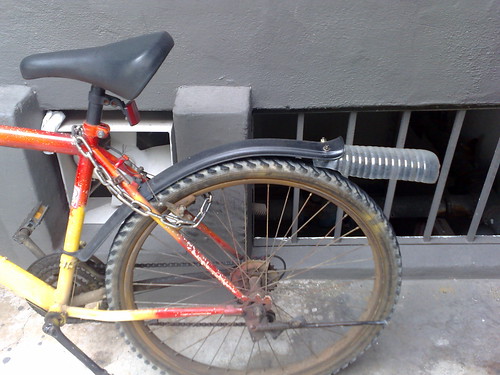
Saw this improvision from mrbrown's Quick Guide to Bicycle Commuting in Singapore. It brings back my experiences related to rain and cycling.

1. Most of the time, rain doesn't stop, it is the ... cloud that moves.
This is the first lesson I've learned. The first time I was caught in the rain, without rain coat, I was together with some other motorcyclists under a shelter. A short while later, the rain "stopped". However, those motorcyclists didn't show any sign of carrying on their journey. Another couple of minutes passed and they are still waiting. I didn't understand why, and so I moved on. Just only a few minutes later I saw the boundary of the rain, and too late to react and I rode into the rain, again.

2. No more rain, but the floor is still wet.
On another ocassion, I waited till no more rain, and added another 15 minutes wait for the clouds to be far enough. Happily I moved on. Only when I got back home to change then I realized how ugly was the back of my shirt. The real wheel, especially MTB tyre had "sprayed" my shirt with water on the ground. This led me to my next lesson.

3. These are called mud-guard, not water-guard.
Not knowing what that black thing above the wheel is called (see pic above), I went to the stop and asked if there is anything that can prevent water from hitting my back. This thing was suggested and happily I cycle before the road is dry after a rain. Still, I found my back is still sprinkled with dirty water from the ground. Only later I realized that this thing is called a mud-guard, and thus as the name suggests, it is not designed for the problem I was facing. At that time, I envy those road bikes that have the semi-circle cover to tackle this problem.

4. My favorite material to extend the mud-guard.
I had the similar approach as the one shown in the above pic: to extend the mud-guard. Initially, I used carboard, but it couldn't tolerate water. I put it in one of those transparent magazine wrapper envelope, but moisture still got in and it couldn't last long. The idea of water proof led me to water holding items. I didn't use water bottle like the one in the pic, which I think is quite troublesome. Initially I used those use and throw plastics cups, which are free, softer and easier to cut. However, under direct sunlight daily, it decays within months. Eventually, the best material I have found and used is transparency. It is not free, but I can get those used and unwanted ones. It is light, nice looking, firm when curved, and able to last for years under direct sunlight.

5. Rain coat doesn't keep you dry.
After being equiped with a rain coat for months, finally, I have the chance to use it. Happily, I put on the rain coat and moved on. It was so stuffy. Then becoming sticky. By the time I reach my destination, I was drenched. The rain coat kept me from the rain water but also prevented sweat from drying up.

6. Headdress.
Another problem with the rain coat is that it can't cover your face, especially when cycling, the wind keep blowing the head cover backwards. Thus, my spectacles have too much water to be usable, and my eyes soon have difficulty opening with water keep running into it. For people like me who don't wear helmet, it is good to have a cap to hold the head cover in place and also to provide shelter to your spectacles and eyes. Furthermore, headdress is also useful to block the sun.

7. Avoiding is the solution.
Nowadays, I don't have the mud-guard. I don't carry rain coat with me. I carry umbrella, but I avoid using it while riding. If caught in rain, I am ready to lock my bike nearby, use umbrella and continue my journey via public transportation.

Monday, June 9, 2008

Additional notes about cycling

This post is my comments to the post by YongWei. ... (The numbers correspond to those in his post.)

2. After two experiences of brake cable snapping off, I understand it is VERY dangerous to ride down bridges on slope.

6. I learned my lesson in trying not to fall, and eventually fell uglily. The lesson helps me a lot during my worst fall when once my fork broke apart.. I rolled 2-3 times, stood up regain breathing only after 10 over seconds of jumping. Luckily, I was on a park connector. The old man who install a new fork for my bike told my brother (I was too injured to retrieve my bicycle) that in his decades of dealing with bicycle, he never saw the way my fork broke apart.

7. I have only been chased by fierce dogs once when I rode down along Woodlands Road toward Customs close to midnight. I guessed the dogs were shocked by the sudden detection of a fast moving intruder. I pity the one that managed to catch up to me and "attacked" my rear wheel.

12. I suspect that cats do not run away from danger when panic. So far, two cats dashed to their safety in the direction that they need to go underneath my bike, and created a spike on my heart rate.

18. Once I brake hard on a downward slope along Irrawaddy Road when a blur lady driver made a right turn out from Novena Square carelessly. Next I realized my tyre punchured. Now I know why.

20. Yes, yes, yes! Even as a pedestrian, I will intentionally delay any cyclist who ring the bell behind me on a pedestrian path.

27. Cycling is usually faster than bus on downtown roads. If I choose to overtake, I make sure I can maintain in front of them. Otherwise, I'd relax and let them pass me way ahead. Every overtaking, either way, is a risky situation.

Thursday, June 5, 2008

Be careful how you ask a question

A JC friend returned from US to this region recently for a short visit. He is into research on student's thought process when learning math. I took a quick browse of his PhD Thesis and found an experiment by Cramer, Post and Currier (1993). I tested it out at Yahoo!Answers. However, it doesn't work as expected the first time. Then, I rephrase the way I present the question, and ... it works the second time.

I suggest readers to try it out first and see the results I got from Yahoo!Answers.
Sue and Julie were running equally fast around a track. Sue started first. When she had run 9 laps, Julie had run 3 laps. When Julie completed 15 laps, how many laps had Sue run?
Link to my experiments: Does your answer make sense? (for students)? and Quick, how many laps Sue ran?

Indeed, even in normal life events not necessary mathematical, the way we ask does affect the way the other party responds.

Friday, April 25, 2008

Will teachers like me?

It has been coming to attention by more parents that students are working harder than adults. Although my son is still very young or small, I have this idea years before I was promoted to father.

I plan to teach my child that an important aspect of studying in school is to learn. Thus, doing homework ... not about answering to the "boss" aka the teacher. is towards this goal too. I don't consider cannot finish homework as a direct problem of the child. I will focus on whether he has learned what is being taught.

If no, then the problem is not he not able to finish all the homework, but he hasn't learned the concepts yet. Thus, he should stop doing the homework without understanding rather than just try to finish the homework.

If yes, then he doesn't really need to finish the homework. When the amount of homework is too much, I suggest be smart to browse through and select those that can give you the necessary and sufficient practices to learn and apply knowledge learned.

So, future teachers of my child please take note :)

Tuesday, February 5, 2008

You can't hear it, but ultrasound is calling for you.

This site, Medical Career Training reminds of the drama series Heroes, where the lead character, Peter Petrelli is a nurse. It is getting more common to find male nurse. Indeed, it is not only in the nursing profession, but the in the field of medical careers, which is one of the fastest growing areas of employment today.

Medical career is not restricted only to physicians and nurses, but also consists of many other roles since a number of sophisticated medical instruments, such as Computed Tomography (CT) and Magnetic Resonance Imaging (MRI), require a team of qualified people to operate them. Of these, one interesting career is to be a Sonographer, by getting trained in an ultrasound technician school.

Sonographers use special equipment to direct sound waves into areas of a patient's body. Ultrasonographers properly operate the ultrasound equipment, which forms an image that may be videotaped, transmitted, or photographed for diagnosis and/or interpretation by a physician. Sonography is becoming increasingly attractive as patients seek safer treatment options, and sonography provides an alternative to radiology procedures.

I am also in the medical industry, as a technical researcher, mainly dealing with CT and MRI images. Ultrasound is a much easier, safer and faster way of medical imaging than CT and MRI.

You can check out where are these ultrasound tech schools from the site and other details. They categorize them according to which state there are in, and also a list of online schools.

Saturday, December 8, 2007

Get ready for exam

Education encompasses knowledge, teaching, learning, remembering, application, etc.

Is something missing?

Oh yes, exams and tests! However, these are not necessary in education although evaluations to feedback errors and weak areas for further strengthening are necessary.

Ironically, exams and tests are the two most talk about than all the other areas.

These two are there to serve the industry. In many industries such as real estates, insurance and finance, for the sake of the general public consumers, there are many qualifying exams to certified agents in these industries to be qualified to provide professional services.

Take for example, dealing with mortgages, there is the Mortgage Test. In this exam-prep.com link, you can find resources to prepare yourself for the test. Resources include CompuCram® Exam Prep Software that guarantee to help you pass your mortgage exams the first time. It contains huge database of exam styled questions by industry experts to train you as much as you choose to.

In my days, sometimes we paired up with classmates to test each other while preparing for tests and exams. With CompuCram® Exam Prep Software, you can do that repeatedly without bothering someone else.

This reminds me of the similar kind of software that my middle school English teacher developed to teach English Grammar. Thinking of it now, it was very amazing as that era was before MS Windows, with many fruits-branded (including Apple of course) computers, while he wrote it on his Sinclair Z80 (if I remember correctly) using the BASIC computer programming language.

That program was effective. Surely, the CompuCram® Exam Prep Software would be much better!


Post Sponsored by exam-prep.com.


Friday, September 7, 2007

When they love to learn, they'll learn.

I like this phrase: When they love to learn, they'll learn. I found it at the SCORE! Educational Centers website that have Innovative Tutoring programs.

I had been a tutor for many years since my high school time. After a bad experience tutoring lower secondary levels (age 13-14), I only choose higher level students. Teaching and tutoring is easy, when students want to learn.

I wasn't good in motivating students, which I thought it is the parents' responsibility. However, most parents do not know how to do that. Making things worse, sometimes teachers and classroom environment de-motivate students from learning.

In a couple of months, I will be a father. Then, in a couple of years, children education will be my major concern as a father rather than as a tutor. I will surely be very interested to what SCORE! is offering. As my blog title put it, back2nature. Children naturally loves to play and have fun, and in doing so, they learn. Thus, the play and fun elements are fundamentally necessary in good education systems.

This Post Sponsored by SCORE!


Sunday, August 26, 2007

For Primary levels mathematics teachers

I'm delighted to find this site, which in many ways have similar views as I on problems and misunderstanding when learning mathematics.

abstractmath.org

Thursday, August 23, 2007

Pattern-recognitional mathematics

Another best answer by me :)


---

Asked by quantum_dot: Why do children make zero and decimal position mistake while dividing?
For e.g.: 21 divide by 2 is 10.5, but many times children end up with 1.5 as the answer
---


1 year ago - 6 answers
Best Answer - Chosen by Asker

I suspect this error is possible because the child is not learning maths, but merely pattern recognition. If the child learns numbers and calculation the mathematical way, she (from my experience, higher chance is a she) will know 1.5 is very unlikely to be the answer, since it is so much smaller than what would be expected for when a value near to 20 is divided by 2.

However, if she were pattern recognizing, 1.5, 10.5, 15, 15.0 are similar patterns.

I recommend more focus needed on the 'feeling' of values and their representations using Arabic numbers. I think more practices on estimation might help. E.g. ask them to estimate, using their perception on the values that are represented by numbers to give rough descriptions of the answer. E.g. before applying method to exactly calculate the value of 21/2, ask them to describe the answer. Will it be bigger than 21? Will it be smaller than 2, will it be near to 0, 10, 20, 30, etc.? Will there be decimals? Etc.

Another advice, forbid the use of calculators! Lower the importance of getting the exact answer.

Just to share, I was amazed when a 20+ year-old working adult couldn't figure out why 3/2=1.5, but he can tell you in split seconds that a meal that cost $3.00 shared by 2 persons means each has to pay one dollar and fifty cents, or one-fifty, which in numeric form is $1.50! Why, 3/2 is so different from 1.5, and he probably find it complicated to rationalize the pattern-transformation in order to transform 3/2 to 1.5, but $3.00 and $1.50 are money to him, not numbers, and he has good sense of money :)


Wednesday, August 15, 2007

Must Pythagoream Theorem be used?

This question is found in the Yahoo!Answers as one of the question designed to test knowledge of the Pythagoream Theorem.

1. Sam hiked 48 miles directly east and then 36 miles directly south. Find the shortest distance in miles from the point where he ended up to his starting point.
A. 60 miles
B. 36 miles
C. 48 miles
D. 72 miles

For me, MCQ question should not be solved by calculation because answers are suggested and the little time allocated, it is designed not to be calculated.

If it is used for training, it is better to demand students to think and explain briefly on all the 4 suggested answers, instead of ignore them, just work out an answer and search to see which of the suggested answer matches it.

Here, obviously, B and C are wrong because from the question, Sam travelled 48 miles in one of the direction and both directions didn't make an angle of less than 90 degrees.

Thus, left with two possible answers A and D. Since 72 can be nicely expressed as 2x36, and if it is D, then probably you should have learnt another theorem about this nice feature. Thus, it is unlikely D.

So, assuming the MCQ is not faulty, and by considering the time and marks allocated ratio, it is wise to choose A and move on. When all is done, then can return to do checking with the left-over spare time. If the MCQ is faulty, it doesn't waste your time too since none will get it correct :)

Now, for the purpose of learning, it is better not just to calculate, but to figure out any nice pattern if the distance were 72 miles. By Pythagoream Theorem,
a^2 + b^2 = (2a)^2 ==> b^2 = 3 x a^2 ==> b = sqrt(3) x a ~ 1.7a > 1.5a ==> 1.5a < b, but
1.5 x 36 = 54 > b, thus distance cannot be 72. Alternatively, similar can be derived in a circle when a chord has same length as the radius, the chord that joins the other two ends of this chord and of the diameter that touches of this chord, is of length sqrt(3) x radius. Lastly, just a quick note, when using the standard way, it is faster to use mental calculation: 36^2 + 48^2 = (12x3)^2 + (12x4)^2 = 12^2 (3^2 x 4^2) = 12^2(5^2) = 60^2.

Saturday, June 9, 2007

First impression

There has been talks recently on how much false information can be acceptable in resume. I think this is an area lacking guidelines. Potential employees try to give the best first impression. Good employers probably ignore all these gimicks. It is similar to guys trying to give good impression to girls, and the smart girls look at deeper contents, and vice-versa.

Personally, I prefer the old style of apprenticeship, with enhancement by the modern systematic evaluation methods.

Monday, May 14, 2007

You will fall down.

I find it weird that parents like to "curse" their kids. I trust the natural instinct or learnt balancing skills in us. Sometimes kids may be in a higher risk of falling, but higher risk is not definite.

Tuesday, May 8, 2007

Non-mathematical skills

Some non-mathematical skills taught in mathematical lessons

  1. cancellation
  2. change the sign
  3. move the decimal points
  4. move the term to the other side of the equation

Thursday, May 3, 2007

Why mathematics teachers teach non-mathematical stuffs?

Recently, I gave tuition to secondary 1 students, and I think nowadays mathematics teachers are skipping steps, while last time only students skip steps.

For example, 3x + 6 = 18, and the next line we put 3x = 18 - 6.
Mathematically, we subtracted 6 from both sides because we want to single out the variable x.
However, this is usually not being taught, or it was just mentioned without any intention of teaching by assuming that students won't understand. As a results, I saw in student's workings this: above the first equation, there is an arrow from above the number 6 going across to the right side of the number 18. That is, what students have learnt was they just "move"/"throw"/"bring" the number 6 over to the other side, and "change"/"convert" the plus sign to a negative sign. What is this!!! Learning mathematics, or learning magical or pattern rules of manipulating symbols?

There are many more such non-mathematical stuffs that are taught in schools!

Friday, March 16, 2007

Lateral Thinking

Recently I just came across lateral thinking, although it was proposed some decades ago. I found my way of thinking is quite close to it. However, my experience is that not many are used to it. Most of us are more used to problem solving.

In a way, solving a problem is some how the minimal achievement. Much much more could be done with or without the problem being solve, and especially so when in situations where not even an existing problem could be recognized.

If relating to performance, it is like considering doing one's best as the minimal achievement, while performing more than required being the norm.

E.g. most students are happy when the their answers to a maths problem is the same as the given answer. This actually is just the minimal achievement. One may solve the problem in more than a way. One may reason out why solving it in another way is wrong. One may discover any redundant information given in the problem. One may transform the problem into a more difficult and challenge oneself. In so doing, the student is truly fulfilling the purpose of a student, which is to learn, not just with a false "worker" mentality by just "producing the solutions/answers" to their "bosses" aka teachers.

Friday, July 21, 2006

tests and exercises

A friend commented that her kids will get zeros for their spelling tests the next day if she is not free in the evening to coach them. I feel something not proper here. What are tests for? If they were for the teacher to know the progress of their students, then when the results of the students include effort from their parents and others, the teacher will miss out those students in need of more coaching. I think students and parents of young kids should be explained clearly on how the education system works.

What are the differences between various tests, exercises and exams? Exams are basically for the purpose of qualifying someone's ability. Thus, one strive to score, by all sort of ways, including churning out good answers even without understanding it, and hiding any signs of 'blurness' about the subject.

On the other hand, exercises are for the purpose of evaluating the performance of the teaching and learning process. Thus, very different from exams, one should be very honest, reflecting whatever understanding he has gained through the lessons within the teaching system, specifying the source of knowledge if it were not from within the system. At the same time, the teachers are to figure out ways to improve on the teaching/learning process, instead of just wonder what's wrong with the student.

Tests are the confusing ones. These are conducted in a more controlled way than exercises such that a more unbias evaluation can be achieved. However, many tests have their scores affecting the final qualifying process, which introduce bias since student will hid their weakness and give answers they recognise as correct, but don't understand. A way to reconcile is not to view tests as evaluation tools but trainings and simulation practices to prepare students to perform well in exams.

Personally, I prefer more evaluation sessions, exercises and tests, and minimal qualifying sessions, exams and tests. Evaluation sessions aim to improve the whole teaching/learning system, benefiting the school, teachers and students. Qualifying sessions are for practical reasons such that other organisations can use to select their preferred students. However, the sad news is, most organisations find many of these qualifying sessions are not really suitable for them, and the more resourceful ones will conduct their own assessment. I think objectives of an educational institute should focus more on teaching rather than qualifying. It is also fairer for an independent qualifying institute, and more effective for the employer or higher institute to conduct qualifying sessions for the incoming cohort.

Wednesday, October 20, 2004

Fairness in exam

Recently there is a hooha in the primary 6 Science examination in Singapore (PSLE). Some students sob while doing the paper with ‘difficult’ questions as complained by these students and their parents. For me, there is nothing much to worry about when there is a very difficult question in the examination paper, because probably most will lose the marks for the question. Similarly, there is not much to cheer about when there is a very easy question because almost all will score the full mark for that one. Thus, I suspect that the problem lies in the attitude that they believe and expect full marks if they have put in the sufficient amount of preparation. Thus, for those who have put in more than sufficient efforts and who believe that they are entitled to full marks if there is no fault from them during the examination, they probably have felt being cheated or the situation is very unfair to them.

Should the examination system be perfect with total fairness? I prefer not. Considering the education in school as the preparation process for students to survive in society, it should not differ from the actual world too much. The real world is not fair, surely not in perfect state. Although the school should provide a protected environment for students to experiment and explore and learn, it should not be too protected and over perfected such that students will find it quite tough when they eventually have to live in the outside world.
Related Posts with Thumbnails